Who the Horned God really is

By Thomas LeRoy
“Even if one recognizes the character inversion employed by changing Pan (the good guy), into Satan (the bad guy), why reject an old friend just because he bears a new name and an unjustified stigma?” ~ Anton LaVey
The Horned God represents the primal power of nature, the human as animal, the beast within us all. A beast that should not be ignored. I fully understand that the Horned God from today’s pagan perspective is a 20th-century invention. This version is the consort of the much more important “Goddess”. He is a happy hippie who sits around with bunnies in a meadow, ready to service her.
What I’m referring to when I say “Horned God” is something deeper, something truly ancient. Besides the Sun and Earth, he is perhaps the most primal of gods, not only historically, but psychologically. It is believed that reverence for a Horned God dates back to the Paleolithic. Even though the name of that original horned god etched on a cave wall has been lost to antiquity, his essence lives deep within the human psyche, surviving in the collective unconscious. And that’s what we’re after in the organization The Sect of the Horned God, getting to that core primordial truth, not through faith, but through philosophical, psychological, and historical means. I’ve always been the type that likes to dig deep to discover the core truth behind any given subject. This is reflected in my interest in history, anthropology, genealogy, and so on. And the occult is no different. And with The Sect, I’m daring to cast a wide net in an attempt to pull up more than just the contemporary left-hand path practices. For example, is there a PIE Horned God that connects Cernunnos of the Celts to Pashupati of the Hindus? They look very similar with similar attributes. And why does there seem to be a connection between the LHP and the Horned God archetype? Is this why the Church in the Middle Ages fused the characteristics of the pagan Horned God onto Satan?
“The combination of horned gods, one Celtic (Cernunnos), one classical (Pan), produced a very powerful deity around which the “pagani” rallied. Indeed, so powerful was this god that the Christian priests cast him as the prototype of the Devil . . . ”
~ Georg Luck
The Horned God has been called “The God of the Witches”, “The Consort of the Goddess”, “Guardian of all things untamed”, “Lord of Shadows”, “Master of Darkness”, and the “Devil” by the Church. He is the antithesis of all that the Christians saw as holy for he represents power, lust, carnality, death, and knowledge. And for their dogma to survive and for there to be calm within the flock, the Horned God’s traits in the human character must be subdued. But the early Christians knew that the Horned God was a large part of what a human being is. By telling people that who they are at their core is evil, they created a very effective way of controlling the masses. Thus, they made the Horned God synonymous with the supreme “bad guy” in their mythos.
The Sect of the Horned God was created to bring about a rejuvenation of the Horned God archetype by revealing his many faces as the anthropomorphize primal essence of the LHP. What I’m after, both historically and psychologically, is the core truth of this philosophy. Even though the modern pagan community doesn’t want to admit it, there is a real connection between the Horned God and the LHP, because gods such as Odin and Shiva have horned god roots. In their raw form, these gods were not compassionate father figures. They were gods of wrath that have been around for a very long time, and, as stated, if the past was brutal, then it would have been reflected in mythology. And the foundation, the religious or moral philosophies of any given society, would reflect this fact. That’s what the predominant religion of society does, it establishes a deep, cultural framework, whether we like it or not. So, if you have a barbaric warrior culture, the myths — and the gods that populate those myths — are not going to be ones of compassion, and empathy. Their archetypal motivation would be for the benefit of a specific populace. And for a society to survive in a savage age, then brutality would be the norm. Thus, the “Gods of Wrath” would take center stage.
“But what about Rome?” you may ask, “Didn’t they adopt Christianity as their official religion, and they were brutal?” Yeah, and about 160 years after the adoption of Christianity the Western Roman Empire was no more. There were many reasons for the collapse, but one valid reason was they substituted a master morality for a slave morality. According to Friedrich Nietzsche, the two primary types of morality are master morality and slave morality. Master morality is where “good” and “bad” are equivalent to “noble” and “despicable”. Slave morality’s standards hold to that which is beneficial to the powerless and weak, such as sympathy, kindness, and humility. Thus the strong, confident and even the individualist are evil.
What we know of the Gods of Wrath here in the West is opaque, for the myths and legends of the distant past have been coated with a veneer of Christian slave morality. This being so, it’s somewhat hard to make out the details beneath the surface. An example of this Abrahamic abridgment would be the writings of early 13th-century Icelandic historian and poet, Snorri Sturluson. First off, we should all be thankful to the man for his writings because if he hadn’t done so, we would know very little of the Norse gods. But in his works, he turned the dark god Odin into a quasi-Norse Yahweh. This was because Snorri was a Christian, and it was hard for him to view the gods any other way than by the good/ bad duality. Even though Odin did some horrible things, often directed at the other gods, in Snorri’s eyes, he had to be a good guy. It couldn’t be that the Allfather had a shadow side. The problem with most modern pagans is that they believe these safe versions of the gods are the original versions. They need to do this, censor the gods because the brutal reality of what they were would make them weep.
Well, this brings us back to the Horned God. And if you’re discussing the horned god with a glassy-eyed, tree-hugger the “Goddess” will come up, along with a “Blessed Be”. Neo-pagans see the Goddess as the “Holiest of Holies” while the Horned God has been relegated to the position of Her “boy toy”. This feminized cartoon version of the Horned God co-insides with their white-light beliefs. But, then again, some people are drawn to the ethereal, and if you are and want to get lost in a great cosmic collective filled with unicorns and rainbows, then maybe this safe modern version of the Horned God, and the gods in general, is the thing for you. Grab your tied-dyed moo-moo and bongos and join them, those happy gods are waiting to give you a big fat hug.
But it’s bullshit! And why do I say it is bullshit? Because I know reality isn’t pretty! Maybe the reason I don’t buy into this nonsense is that I have an independent spirit, and an affinity for what some may call the “darker side of life” and would rather disrupt the herd than join it! So, a more truthful, savage representation of the Gods better suits me. And there are many examples of these gods out there, from Rudra to Wotanaz. But even though I may be drawn to the Horned God, I can’t ignore the Goddess. In my eyes she isn’t some vapid being, spreading white light and rainbows. No. She’s the Dark Mother. She is Kali Ma, the ferocious form of the Goddess, represented with what are arguably the most savage features of all the gods. Where Shiva is consciousness, Kali — in the form of Shakti — is energy, the dynamic aspect of Transcendental Reality. In her ferocious form, Kali both creates and destroys, drunk with the paradox that death feeds on life, and life feeds on death. Kali represents that in the East these ancient Indo-European gods were never coated with the veneer of the Abrahamic. Even though there were attempts by the Muslims to do so.
“An approach via the East will disentangle many of the arguments from the sometimes hopelessly confused jumble we find in the historical sources of the left-hand path in the West.”
~ Stephen E. Flowers, PH.D.
Because of their lack of Abrahamist taint, I have incorporated the Eastern gods into my philosophy and that of The Sect. Where here in the West the gods have been watered down, there, in the East, they’re still full strength. I know in India they have some silly pop-culture versions of the gods, but that doesn’t take away what they are culturally, or philosophically. The Hindus know their true nature.
What I want is to acknowledge the gods as they were meant to be, not what those who can’t get over their Christian upbringing wish they were. I want to experience them because that’s what you do, you don’t worship the gods, you experience the gods, and you should experience them in their true nature . . . raw, bloody, and real.
The Sinister Path
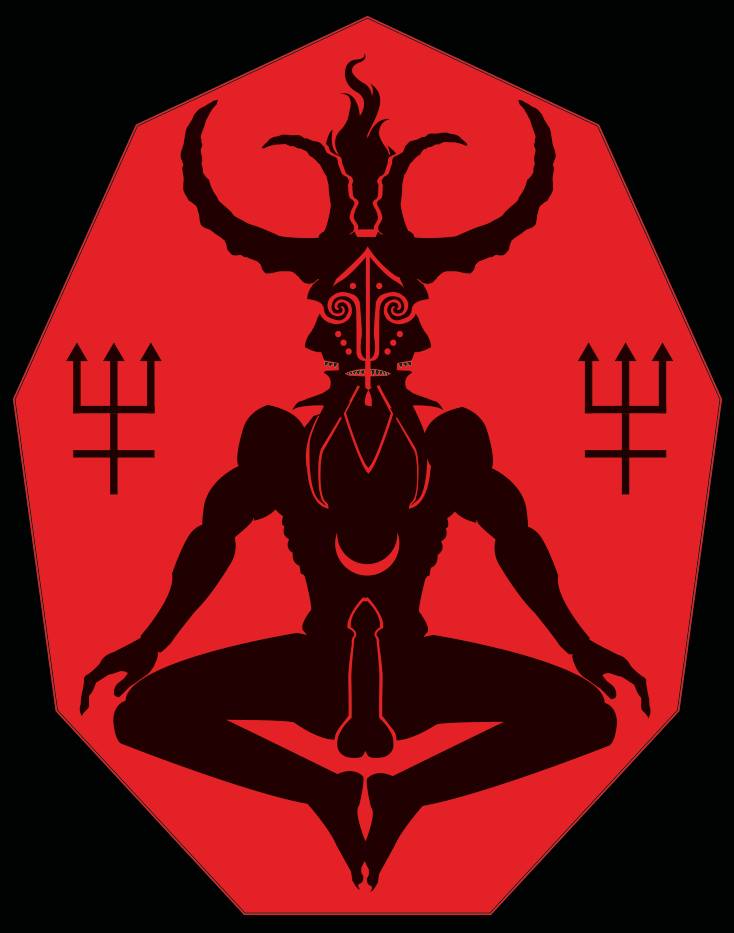
“And he shall separate them one from another,
as a shepherd divideth his sheep from the goats.
And he shall set the sheep on his right,
but the goats on his left.”
~ Matthew 25: 32-33
Interesting Bible verse, isn’t it? An example of the left side as the bad side. This is Yahweh dividing all people, alive and dead. Dividing the good from the bad. His sheep are righteous because of their innocence, modesty, and usefulness. Thus, they go on the right and will enjoy eternal happiness. While the goats, those wicked, wicked goats, will be placed on the left side because of their carnal lust, to suffer everlasting misery. But why is the left often considered wicked? Now, this isn’t true in all cultures, for instance, the ancient Celts associated the left with The Goddess — the source of all life — and thus worshiped the left side, treating it as sacred. In Tantric Buddhism, the left hand represents wisdom. And amongst the Inca, the left-handed were said to possess powers including the ability to perform magick and healing. But, in most cases the left is evil. This theme of the wickedness of the left side was also evident during the Spanish Inquisition when the Catholic Church would condemn — and occasionally execute — those who were left-handed. And across the Atlantic during the time of the Salem Witch Trials, the use of the left hand could lead to one being hanged. But it’s not just the Christians who see evil on the left. The Muslims also honor the right hand above the left: to use the right hand for all honorable purposes, and the left for actions that are, let’s say, not so clean like wiping your ass.
Now, the word sinister, as in “Sinisterism”, has its root in the Latin word sinistra, meaning left. And left, in regards to religion, the spiritual, or the esoteric, has no connection to leftist politics. This is a mistake many people make. It doesn’t mean those who lean toward the political left can’t walk the LHP, it’s just that the roots of these two terms are vastly different. The term left-hand path originated in Hinduism and it means the reversal of the natural right-hand flow of energy. The political left comes from which side of the assembly hall you sat in around the time of the French Revolution. And in my not-so-humble opinion, if you’re on the LHP your political leanings should have no bearing on your path because politics is the residue of philosophy. You take in philosophy and shit out politics. As HL Menken stated: “The only way to look at a politician is down.” This doesn’t mean that politics and politicians don’t impact your life. They do. The same way shit and filth do if you’re wallowing in it.
Sinisterism, in my opinion, is the most suitable vehicle on the path because of its ability to take from many different LHP practices. It looks beyond the East and West philosophical divide to glean that pure gem of truth the individual needs on their quest toward self-deification. A truth that may be different for each individual because where you’re going, I can’t go with you. No one can. It’s a personal journey. Even though those on the RHP may try to tell you otherwise. No one else can accompany you in the depths of your psyche.
Now, have you ever heard the argument that there are no right and left-hand paths, that there’s only one? Some have stated that the way you can tell someone’s a neophyte in the esoteric arts is they claim that there are two paths, and that the paths are an illusion. Well, fuck me for wasting my time over the past forty years! But wait, before I depart to become a Mormon or a granola-eating, moon-worshiping hippie, I have a question for this individual:
If there’s only one path, then why is there more than one destination?
I can understand multiple paths ending up in the same place, but a single path has only one end. And on the left-hand path that ending is you realizing that there is nothing above you, no master, no god, that you are god, something that takes place deep within the psyche where no one else can go. While on the RHP it’s all about you coming together with the flock to achieve the ultimate blessing from something greater than you.
On a side note, here’s a warning for my more theistic friends: Stop calling Satan your lord and master because when you do, you have a kinship with those on the RHP. You’re worshiping something greater than you. The gods can either be the wind at your back, or they can be pulling your leash. And if they’re pulling your leash, then you’re on the RHP. But I digress.
Saying there are no right and left-hand paths is the ignorant ramblings of the misinformed, because, like most of you, I’ve been on both paths. I know the difference. I know how that one path, the path of trying to seek approval from that which was greater than me, filled me with trepidation and a feeling of inadequacy. But it’s a path well paved with signposts telling me exactly where I was going. While that other path, even with its many perils, has endowed me with a sense of independence, because it’s up to me, and no one else to have the confidence to make it to the end. Sure, I can ask others on the Path for some advice, but they’re not going to hold my hand and lead me to the end, because if they were to, then how can I say I’ve accomplished anything?
Do you know what the RHP reminds me of? Reminds me of those baby races, you know, where the parents at the other end encourage their kids to crawl to their open arms. And even if the kid doesn’t make it, everyone knows mommy’s going to come to scoop them up. That sums up the right-hand path, in my opinion, while those on the LHP remind me of rock climbers going free solo up a cliff face no one has before, where it’s all up to them, and no one else, to make it to the top.
Understand that a sheep can’t see beyond the herd, so only a person on the RHP is going to deny the existence of the LHP. A person waiting for mommy to come to scoop them up.
Are you a Sinisterist?
By Thomas LeRoy ~ Founder of The Sect of the Horned God

What is Sinisterism? And are you a Sinisterist? If you’re on the left-hand path, then you very well could be.
The word sinister comes from the Latin word sinistra meaning left. Historically, the left side, and left-handedness, was seen as a negative in most cultures. An example would be if a bird flew by on your left side, it was a bad omen. The left was considered “evil” or “unlucky”, thus giving us the modern English meaning for “sinister”.
Sinisterism, though, is a little used word, but when it is, its most likely by the religious right when sometimes referring to the secular political left. But in the realm of the esoteric, Sinisterism, or Sinisterist, would refer to someone who walks the left-hand path but doesn’t quite fit within an established paradigm. You may not identify as a Luciferian, for example, or appreciate the direction contemporary Satanism is going, but you are still lured by what’s down the Path. You have a hunger that one single paradigm, or discipline, could not satiate, so you take a little of this, or that, from many different disciplines: Satanic, Luciferian, Hermetic, Dark Pagan, Hindu, and so on. Your interest is in the big picture, the philosophy, the psychology, the history and mystery that is the LHP.
For myself, it was Satanism that first put me on the Path. Now, with my personal psychological and philosophical maturation there also came an awareness of my autonomy, so the right-hand path with its societal conformity no longer had any appeal to me. So, like most “Dark Esotericists” in the Western World, Satanism was the first vehicle utilized on the Path. And being an individual with an obsessive nature, when I get into something, whatever it is, devouring all aspects of that topic tends to be the end result. Simply scratching the surface is never enough.
Druidism, the root of much of European esoteric thought, was the starting point followed by Hinduism, Asatru, the dark gods of the Greco-Roman traditions, and so on. Next came the philosophies that corresponded with the Path, and the psychology. Getting down to the foundation, to find that deep psychological under-current that transcends both space and time was the most important aspect.
Because of this, Satanism was not enough. Besides, there was a growing frustration in my gut for contemporary Satanism. It seemed to lose that spark ignited by Anton LaVey. Too many organizations, too many poorly written books, too much anger and pettiness, and so much watering down of the philosophy, now there’s even a right-hand path version. But still my nature was Satanic as codified by Lavey, but the title of Satanist no longer worked for me. Something different was in order. Something that better portrayed my general interest in that “Sinister Path” and all it had to offer. Something that better suited my interests and natural inclinations.
This is why the title of Sinisterist works for me.
Does this also sound like you? If so, then you, too, are a practitioner of Sinisterism and can claim the title of Sinisterist. Why not? You don’t like labels, you say? You say labels are for soap cans? Well boo-fuckin’-hoo, others will give you a label whether you like it or not, so you might as well beat them to the punch. Admit who you are.
You’re a Sinisterist.
Rebellion Vs Religion
By Eric ~ Member of the Sect of the Horned God
I base this essay on the YouTube video by Thomas LeRoy called The Sect Vs Online Satanists as it was moved me because of the message it held. In my mind, rebellion is a way of pushing back against views that you do not agree with, and in most cases, the views of teenagers. A teenager sees the world one way because he or she has not fully experienced everything that life has to offer. A rebellion should have purpose, it should mean something to those who are rebelling, and not have to do with religion.
Religion is a belief system that we are taught or learn as we grow and like some (myself included) the views can change over time. Thomas LeRoy and Mistress Babylon talk about how it shouldn’t matter to anyone what other religions do unless that religion affected us as children. I grew up Catholic and was forced to attend church. I never understood how the church could tell nuns and priests that they were not allowed to have sex, but the abuse of children was a hush hush situation. This is a fine example of who cares, and why rebel against something I cannot control?
To me a Satanist is his or her own god with his or her belief system and someone that respects all religion regardless of how he or she feels about that religion. I used to believe that way that I think today was ridiculous. How could anyone believe in Lucifer as the teacher or the bringer of light? A lot of these views changed for me after reading The Devil’s Apocrypha by John DeVito. Are we simply crazy for believing we are our own gods? Are all religions just mythology made up by man to help us sleep better? I don’t think we will ever have a true answer to these questions.
Like anything in life that we enjoy, we should not allow that thing to control our lives but rather allow it to help guide us only as far as we wish to go. Mistress Babylon talked about indulgence and not allowing this to justify you being an asshole. Yes we all need to calm down and stop pretending that we are somehow better than those who have different views. My path is not rebellion; my path is further knowledge about things I wish to understand.
In conclusion I see the path to enlightenment. I seek my new religion as a way of learning about what I was once told is wrong and taboo. The first time in my life I feel free of societies and families pressure to be part of something that I do not wish to be a part of. I will not pretend to have the answers because I purchased a satanic bible, and I will not pretend I have all the answers. I hope to one day meet others and learn from them as they help guide me to the truth. Religion should not be about hate or being considered and outsider due to sexual orientation, it should be about love and axcepting others for who they are.
Sanitizing History
By Lisa Corrine, Co-founder The Sect of the Horned
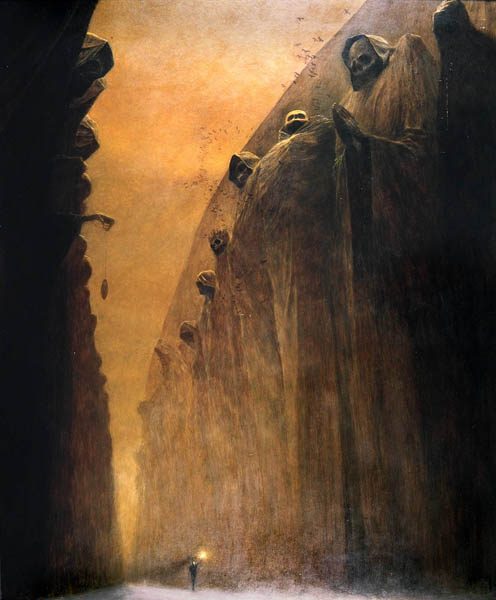
Let’s lower the cultural bar down yet another notch and blow our bubbles of hope to a shiny clean and collectively cramped future while whitewashing the past. Let’s ensure that future generations are ignorant of historical context and conflict, evolving laws, conquests and sorrows. Let’s bind their eyes, ears and voice from sight, sound and questions of how and why.
Monkey See, Monkey Do.
History doesn’t disappear despite how hard you try to force it within the coloring book lines even though the Mandela ones are still very pretty. It’s like chaining your demon to the root cellar wall and ignoring their cries. The interpretation of past events in the (dimming) light of a contemporary perspective, Presentism, is the ballad of the ignorant and bleat of the weak, a soap box to stand on where no arrows are thrown. A safe, brave, and courageous position, no doubt, yet you cried for compassion when your garden flowers died.
It’s a presumptuous position of turnabout bias.
Prometheus

by Thomas LeRoy, Founder of The Sect of the Horned God
“One thing that comes out in myths is that at the bottom of the abyss comes the voice of salvation. The black moment is the moment when the real message of transformation is going to come. At the darkest moment comes the light.”
— Joseph Campbell
What connection does Prometheus have to the left-hand path? In Greek mythology, Prometheus (whose name means “the one with foreknowledge”) had a reputation of being something of a trickster, one with a strong rebellious nature. His role was to stir up the existing order and not to bolster the power of Zeus, but to question it. In his book, “Lords of the Left-Hand Path” by Stephen Flowers, he states, “In the history of the kind of thought we are calling left-hand path in the West, it is difficult to overestimate the importance of the myth of Prometheus.”
To get an idea of the nature of Prometheus, we need to go back to the Greek myths themselves. The Titan Prometheus was one of the ringleaders in the battle between the Titans and the Olympian gods, led by Zeus. The goal was to gain control of the heavens. Prometheus switched sides, though, and supported the victorious Olympians when the Titans would not follow his advice to use trickery in the battle.
Eventually Prometheus was given the task by Zeus to create Man. He shaped Man out of mud, and Athena breathed life into his clay figure. Prometheus had assigned his brother Epimetheus (whose name means “afterthought”) the task of giving the creatures of the earth their various qualities, such as swiftness, cunning, strength, fur, and wings. Unfortunately, by the time he got to Man Epimetheus had given all the good qualities out and there were none left. So Prometheus decided to make Man stand upright as the gods did and, feeling sorry for Man’s weak and naked state, Prometheus raided the workshop of Hephaistos and Athena on Mt. Olympus and stole fire.
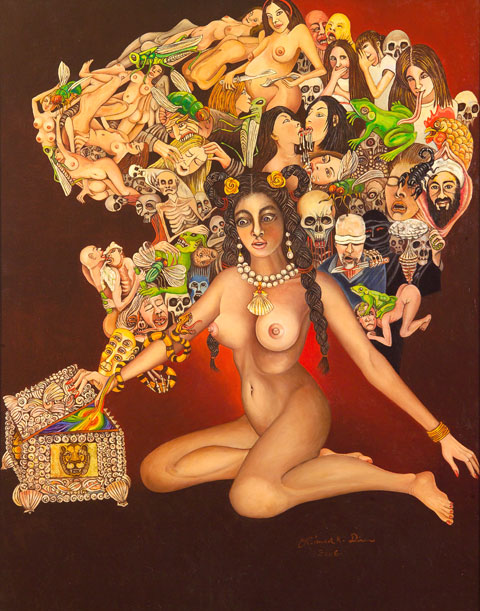
Partially with revenge in mind, Zeus sent Epimetheus a gift of the first woman, Pandora, who like Eve was blamed for causing all the evils humanity has had to suffer. Along with the curious woman, Zeus sent a closed box, telling Epimetheus it was not to be opened. Naturally Epimetheus gave the box to Pandora and, out of curiosity, she opened it. Out flew all the evils and plagues of the world: sorrow, disease, pestilence, war, etc. The only thing that remained in the box was hope.
Zeus, still angry with Prometheus for the theft of fire, sent his servants, Force and Violence, to seize the Titan and take him to the Caucasus Mountains where he would be chained to a rock with unbreakable adamanite chains. Here he was tormented by a giant eagle tearing at his liver. To add to the torment, the liver re-grew every night and the eagle returned each day to perpetually torture Prometheus.
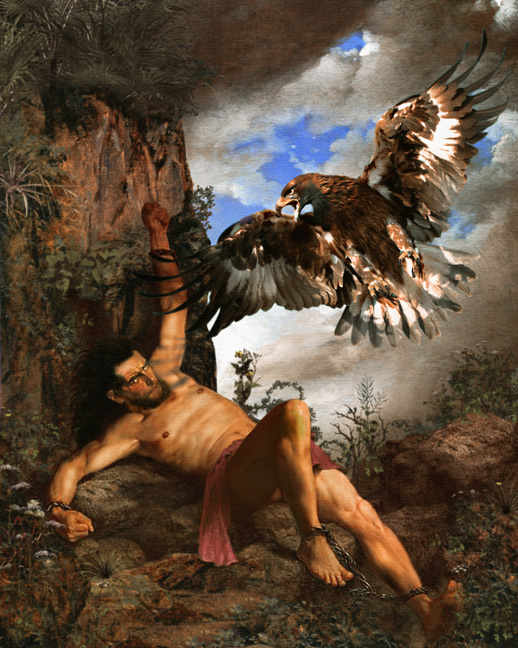
But Zeus gave Prometheus a chance out of this predicament if he met two conditions. The first was that an immortal must volunteer to die for Prometheus, and the second was that a mortal must kill the eagle and unchain him. Eventually, Chiron the Centaur agreed to die for him and Heracles killed the eagle and unbound him.
Because of certain rebellious qualities, Prometheus has similarities to the Christian interpertation of Satan. In the book, “Lucifer and Prometheus” by R.J. Zwi Werblowsky, it is argued that the Satan of John Milton’s Paradise Lost is a strangely appealing character because of the attributes he shares with Prometheus. The book also points out the essential ambiguity of Prometheus and his dual Christ-like/Satanic nature as developed in the Christian tradition. Werblowsky also uses the terminology of Carl Jung in examining “mythological projections of the human psyche”, though he emphasizes that he is not interested in the concept of the archetype in the strict Jungian sense. Rather, he sees the myth of figures such as Satan and Prometheus as expressing “the shortcomings … of the world as conceived by the human soul.”
The myth of Prometheus is not simply a tale explaining how humans received the essential tool called fire, it instead metaphorically relates how we came upon that divine gift, that quality of the gods called intellect. The left-hand path is the individual’s quest to achieve divine power, or self-deification. And needed to journey this path is our own personal light. Without that gift from Prometheus we would be nothing more than beasts, naked on a path of ignorance, searching, crawling blindly toward any distant light.
Azazel
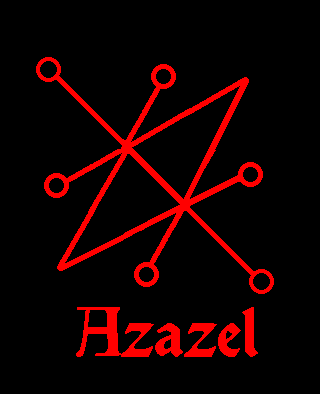
by Thomas LeRoy, Founder of The Sect of the Horned God
“The whole earth has been corrupted through the works that were taught by Azazel: to him ascribe all sin. ”
— 1 Enoch 2:8
Azazel (name said to derive from “azaz” and “el” meaning “Strong one of God”), is the chief of the Se’irim, or goat-demons, who inhabited the desert and to whom most primitive Semitic tribes offered sacrifices. But in the Book of Enoch it states that he was the leader of the fallen angels, and is often identified with Lucifer (the Lightbringer) or Lumiel (‘the light of God’). In other ancient texts, including the Torah, and the Zohar, Azazel was refered to as the “Seed of Lilith”. These texts further hint that Azazel was not the product of Lilith mating with any ordinary man, but rather he was the first-born son resulting from her illicit mating with Semjaza, the leader of a group of fallen angels called Watchers.
In one account in the Book of Enoch, it was Azazel who educated humankind of heavenly secrets that lead them to sin. He taught ancient men metallurgy and how to mine from the earth and use the different metals to forge swords, knives, shields and body armour. To the women he taught the art of making ornaments, rings and necklaces, and how to “beautify their eyelids” with kohl and the use of cosmetic tricks to attract and seduce the opposite sex. From these practices Enoch says there came so much “godlessness” that men and women committed fornication. He also revealed to the people the secrets of witchcraft, thus leading them even further astray. Eventually the angels brought charges upon Azazel and presented him to the Lord for the crime of revealing these heavenly secrets to mankind. Raphael was then assigned to punish Azazel by binding him hand and foot and throwing him into the darkness upon the rocky ground. Here he would remain until the Day of Judgment when he would then be hurled into the fire to be consumed forever.
The apocalyptic writers of Enoch brought Azazel into connection with the Biblical story of the fall of the angels. This growing chasm between God and some of his “sons” is important in understanding the emergence of the Satan character as we know him today. Not only does this division preserve God’s righteousness, it also begins the evolution of a single being to become the antithesis of God in Judeo-Christian mythology.
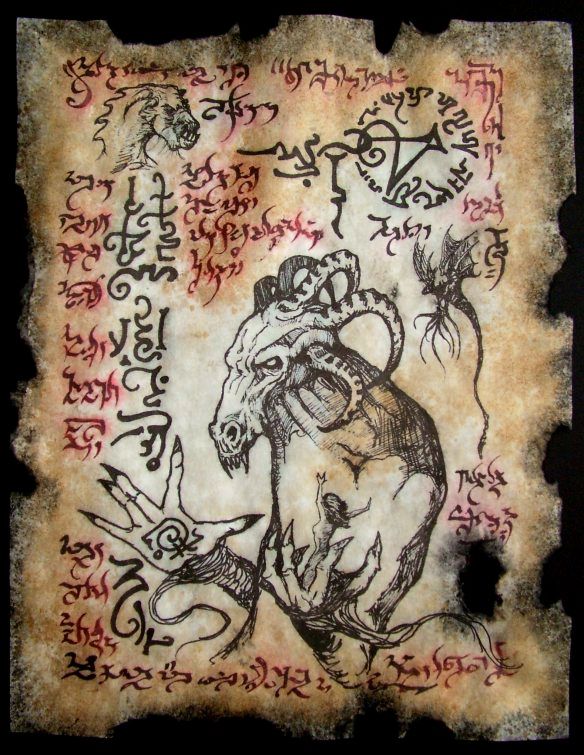
Because of Azazel’s connection to the Se’irim, his name has become synonymous with the word scapegoat. On the 10th day of September, on the feast of the Expiation, it was Jewish custom to draw lots for two goats: one for Yahweh and the other for Azazel. The goat for Yahweh was then sacrificed and its blood served as atonement. With the goat for Azazel, the high priest would place both of his hands on the goat’s head and confess both his sins and the sins of the people. The goat (“scapegoate”) was then led into the desert and set free. Symbolically, the scapegoat took on the sins of the Israelites and removed them.
Thus, Azazel carries upon him the people’s sins. Not unlike a certain Nazarene, another mythological figure from the Middle East.
Satanism and the Eternal Recurrence
by Thomas LeRoy, Founder of The Sect of the Horned God
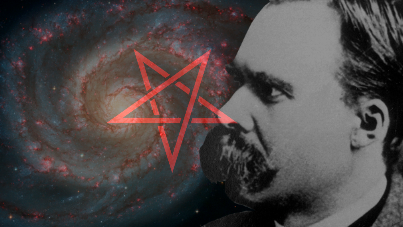
“What if some day, or night, a demon were to steal after you into your loneliest loneliness and say to you: “This life as you now live it and have lived it, you will have to live once more and innumerable times more; and there will be nothing new in it, but every pain and every joy and every thought and sigh and everything unutterably small or great in your life will have to return to you, all in the same succession and sequence – even this spider and this moonlight between the trees, and even this moment and I myself. The eternal hourglass of existence is turned upside down again and again, and you with it, speck of dust!
“Would you not throw yourself down and gnash your teeth and curse the demon who spoke thus? Or have you once experienced a tremendous moment when you would have answered him: “You are a god and never have I heard anything more divine.”
–from Nietzsche’s “The Gay Science”
Nietzsche asked this question of his readers back in the 19th century, and now, in the 21st, how would you answer? Does it fill you with dread, or are you pleased with the idea? Is it a blessing or a curse? The demon’s assertion is the frightening possibility that everything that has happened, or will happen, has already occurred and will occur infinitely many more times, without the slightest alteration in detail, living this same life over and over until the end of time. And the image of the demon suggests that such a visitation would be seen as dangerous and unwelcome. Many would be highly unpleased with this notion. Their lives are filled with misery and pain, pain that is, more often than not, self-inflicted. The average Christian, for example, sees pain and suffering as an important part of their existence. Their beliefs hold that we are cursed from birth, and it is our job to live a humble life before the Lord so He may remove that curse, because the here and now is but a transitory phase. Life is simply a preface to an eternity of bliss. Because of this belief, the Christian would find the idea of the eternal recurrence to be horrific. But how would you, the modern Satanist, react to it?
There should be only one answer — with joy!
Satanists, if you are not already living your life to its fullest, then what are you waiting for? Existence itself should be viewed as something to be relished, all the happiness and heartache, pleasure and pain, should be held in the highest regard. You should have a love of fate — amor fati, the affirmation and acceptance of the whole of life. And eternal recurrence is a way to force attention on life exactly as it is. If one could say yes to eternal recurrence, then one could genuinely say yes to life as it is. One way of dealing with this idea, and to achieve a love of fate, according to Nietzsche, was that one must gain freedom from morality — a revaluation of all values:
“To endure the idea of the recurrence one needs: freedom from morality; new means against the fact of pain (pain conceived as a tool, as the father of pleasure; there is no cumulative consciousness of displeasure); the enjoyment of all kinds of uncertainty, experimentalism, as a counterweight to this extreme fatalism; abolition of the concept of necessity; abolition of the ‘will’; abolition of ‘knowledge-in-itself.'”
Nietzsche’s world-view is that of a “Dionysian world of eternally self-creating, eternally self-destroying . . .” The Dionysian attitude toward life is purely artistic, celebrating aesthetic value (even if it has no epistemic value) and rejoicing in the destruction of morality, especially Christian morality. It is an existence always in flux and the counter to the ascetic ideal of self-denial. In this reality the existential truths hold no sway over the individual. Change is the only constant, and with change comes pain. Strength is achieved through this suffering and true joy can come from over-coming (the will to power). Existence is short, and one must craft his or her’s own identity through self-realization and do so without relying on anything transcending that life, such as God or a soul. Your life should be lived without regret, remorse, or guilt, and open to the love of self, others (if found to be worthy of it) and the world in all its manifestations. This view goes beyond nihilism and is the essence of Nietzschean thought.
It is a way of restoring meaning to life — to your life!
Shiva the Destroyer: Lord of the Left-Hand Path
by Thomas LeRoy, Founder of The Sect of the Horned God
There are many mythological gods and entities on the left-hand path. Lord Shiva is but one. Though not always viewed through the lens of the LHP, he is, in some manner, the greatest of these deities.
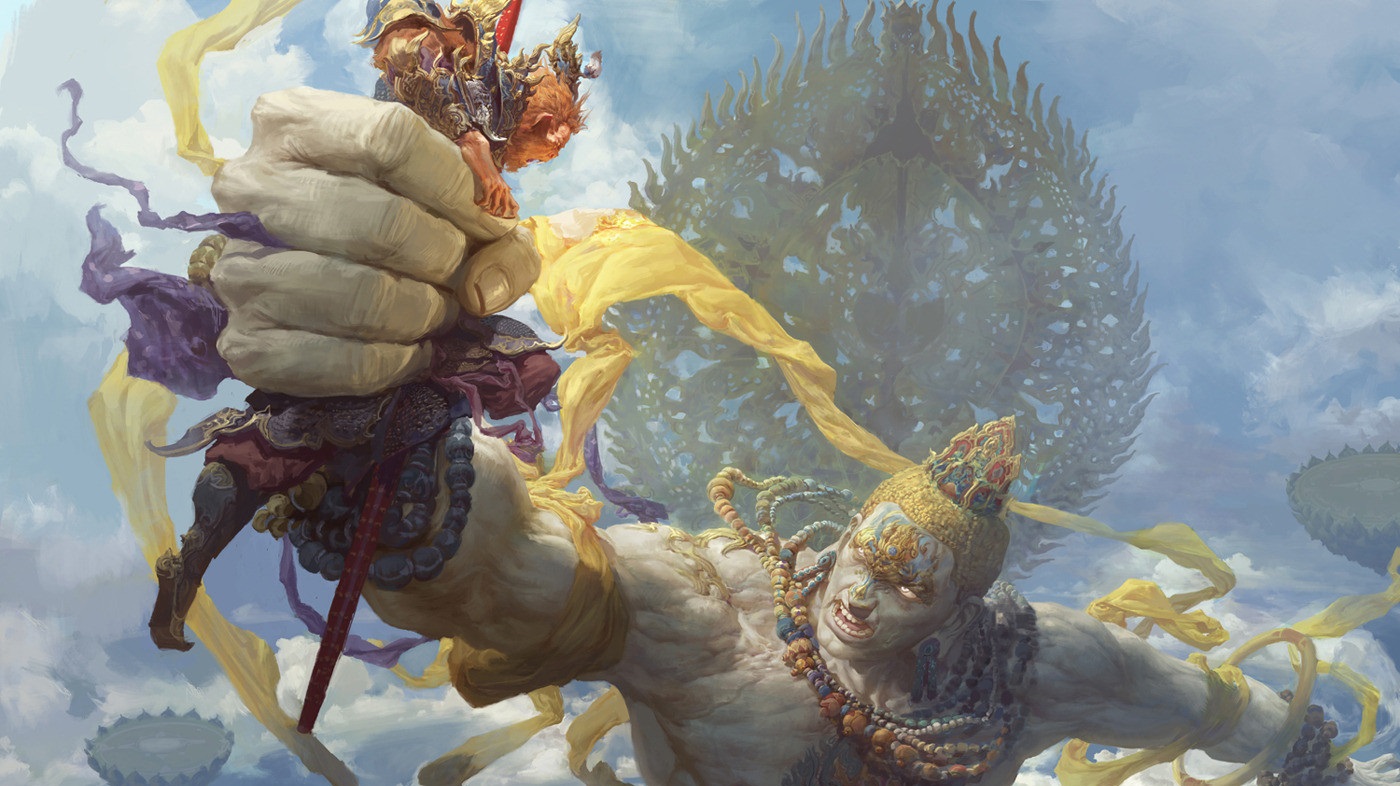
Shiva is one of the most important gods in the Hindu tradition and, along with Brahma and Vishnu, is one-third of the holy trinity of Hinduism. A deity of great complexity, he is often represented as a lord of love, light and protection. But he also has a darker side. Shiva the Destroyer is the leader of evil spirits, ghosts, vampires, along with being the master of thieves and villains. He destroys the universe at the end of each cycle (every 2,160,000,000 years) which then allows for a new Creation. His destructive powers are often terrible, but they also have a positive side in that destruction usually leads to new and better forms of existence. Shiva destroys in order to create, since death is the medium for rebirth into a new life. It is common to see Shiva depicted with four arms and three eyes. A glance from the third eye in the center of his forehead has the power to destroy anything in creation, including humans and gods. In this destroyer role he often lurks the cremation grounds, a serpent representing Kundalini coiled around his neck, along with a necklace of skulls. And it is not uncommon for him to be accompanied by a band of terrifying demons, hungering for blood.
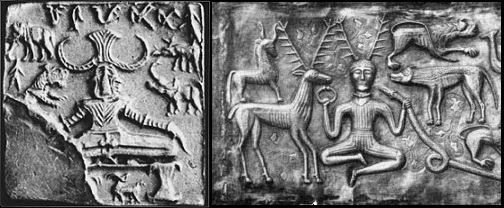
Shiva seems to have a connection to the deities of Western traditions through an ancient horned god of the Indus Valley, a “proto-Shiva”, called Pashupati. In the Skanda Purana it tells how Pashupati used to find calm in a forest called the “Sleshmantaka” . It was here that he spent time being immersed in “the wilderness of this forest.” Depicted seated in a lotus position surrounded by animals, Pashupati had a striking resemblance to Cernunnos, horned god of the Celts, but there is a 3,000 year old gap, between these two gods (Pashupati dating from about 3,000 B.C.). Is this an example of racial memory, the collective unconscious, or do they both stem from a long forgotten Indo/European horned god? It is a mystery to be pondered, but what is also interesting is Cernunnos has been, over time, transformed into an incarnation of Satan, supreme lord of the Western left-hand path traditions, while Pashupati has morphed into Shiva, lord of the Eastern.
Shiva the Destroyer is the most ancient and powerful of all LHP deities. He is the ultimate adversary, adversarial to those aspects of the self that keep one from progressing upon the path. Shiva and the other beings of a mythological nature are not to be believed as objective truths, nor are they to be shunned as lies. They are to be experienced, experienced within the soul/psyche as meaningful poetry of the subconscious.
To meditate upon the image of Shiva,
to utilize the metaphor, to find calm in the symbol that is the deity,
does not make one a Hindu.
Just as contemplating on the image of Satan, does not make one a Hebrew.
Finding the Self on the Left-Hand Path
By Thomas LeRoy, Founder of The Sect of the Horned God
What is the self? You feel as though you are a thing with an intellectual sense, physical, but with an awareness. But try to capture that self. Go ahead. Sit in the dark, close your eyes and try to capture that essence that is you. You can’t. You are the whole of your parts, but not your parts. You are a process, fluid, changing, always in flux; an ever-shifting bundle of thoughts, feelings and memories.
We tend to think the self is as an integrated individual inhabiting a body. But according to neuroscientists, there is no single place in the brain that generates a self. On the flip-side, though, if we are a body inhabited by an undying soul — ghost in the machine — would we be the sum of those past lives? The answer is no. We would not be identical to that man that battled with the Irish forces against the Vikings at the Battle of Clontarf in 1014. Nor would we be that stable boy who had relations with the lady of the manor in 18th century England. We would be very different from those individuals. We would still have our independent identity.
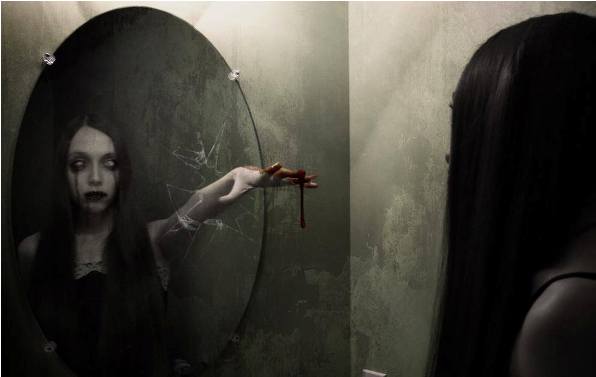
While searching for the self, one cannot simultaneously be the hunter and the hunted. It would be like trying to grasp that image in the mirror with your hands; or having the image try to grasp you. It is you. So since we can’t capture the self, can we then guide it? The answer is yes, but what do we Satanists do with the self so that it progresses in a fashion that is beneficial?
The first question to ask is — are you on the left-hand path? You may call yourself a Satanist, but that does not mean you’re on the path. A Satanist is who you are. It is your identity. Just as some people are introverts and others extroverts, you may have certain traits that fall in line with that label called Satanist. The left-hand path, though, is something you have to choose to take. So, I’ll ask again — are you on it, or are you one stuck in a circle of conformity? A leaf in a stream, going with the flow?
The idea of the LHP is to create your own hero’s journey, to go counter-clockwise while reveling in your personal emancipation. It is taking that which you know as the self and carving your own path. Since you are ever-changing, always in flux, you have the choice to counter that natural flow and defy what may seem to be a scripted order. That scripted order is an illusion. It is you lying to the self. And there is no director guiding that script. If you follow it, though, you will find you have put up walls around the self, restricted it, preventing you from reaching that goal of self-deification. Outside influences may try to re-enforce those walls. It may be your parents, your community, society in general. Vanquish that illusion and instead follow the heterodox path, the LHP, toward the exaltation of the self.
The Orders of The Sect of the Horned God